
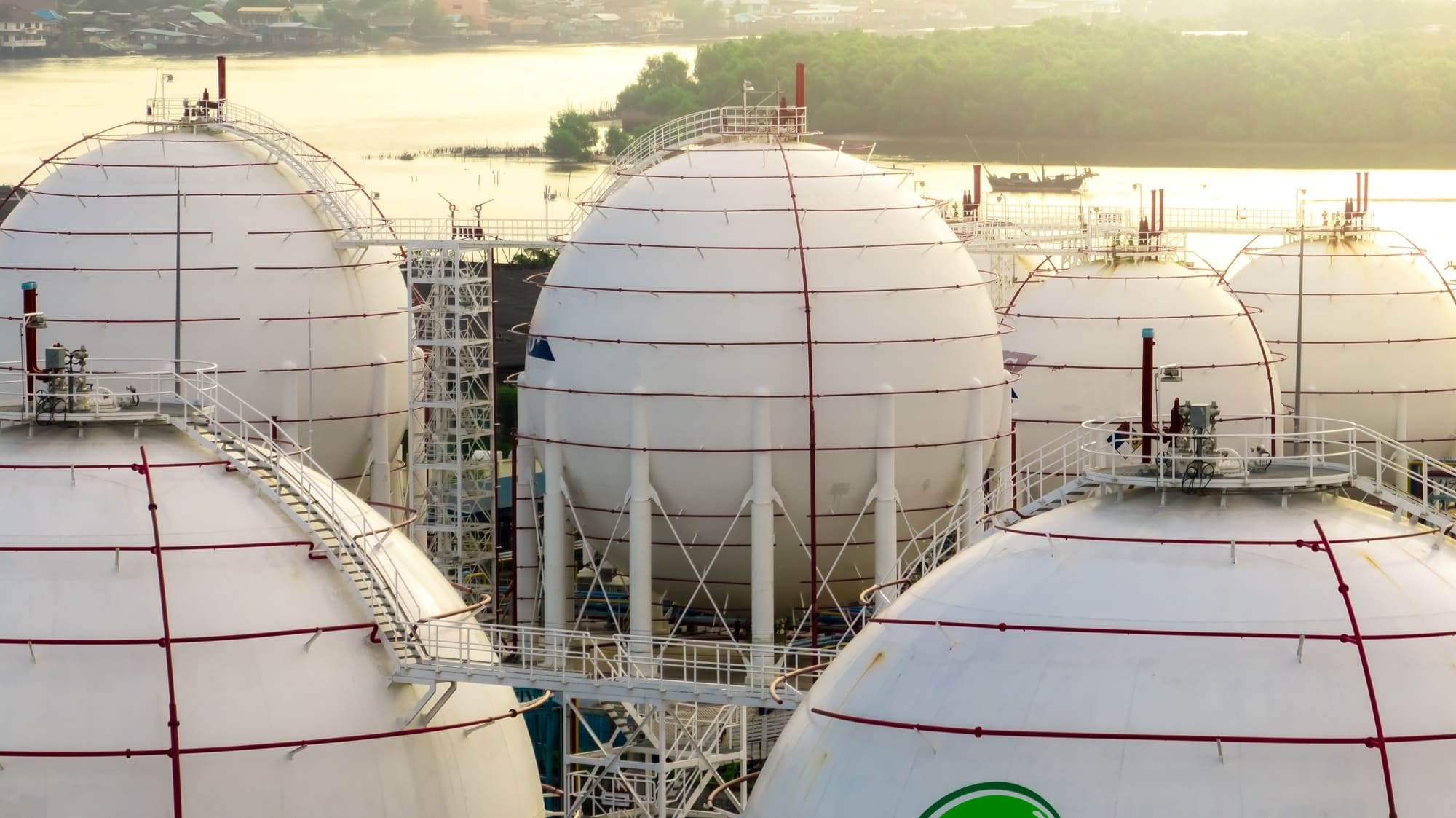
Liquefied natural gas (LNG) has gained prominence as a clean and efficient energy source. For safe storage and transport, specialised tanks are used that are capable of holding LNG at cryogenic temperatures. This article explores in detail what an LNG tank is, the different types, their sizes and key aspects of their construction.
What is an LNG tank?
An LNG tank is a container specifically designed to store natural gas in a liquid state at extremely low temperatures, around -162 °C. These tanks must keep the LNG in a liquid state, minimise evaporation and ensure safety during storage and transportation.
Types of LNG tanks
LNG tanks are classified according to their design and containment capacity. The main types are:
1. Single containment tanks
These consist of an inner vessel containing the LNG and an outer structure providing mechanical support and thermal protection. If the inner container develops a leak, the LNG can escape, which is why they are mainly used for smaller-scale installations.
2. Double containment tanks
These feature an inner container for the LNG and an outer container that can contain the liquid in the event of a leak. The space between the two is thermally insulated. This design improves safety and is used in medium-sized installations.
3. Total containment tanks
These are the safest and most commonly used for large LNG terminals. They feature a nickel-plated steel inner tank and a reinforced concrete outer container, both capable of containing the LNG on their own. In addition, they include advanced insulation systems and thermal protection at the joints.
LNG tank sizes and capacities
The capacity of LNG tanks varies according to their application:
- Small scale: Cylindrical pressure tanks, horizontal or vertical, with capacities up to 1,500 m³.
- Medium scale: Flat-bottom tanks with capacities between 10,000 and 60,000 m³, suitable for regasification plants or regional storage.
- Large scale: Total containment tanks at import terminals, with capacities of up to 266,000 m³, such as those used at Enagás terminals.
Construction of LNG tanks
The construction of an LNG tank involves rigorous technical and safety considerations:
Materials
- Interior lining: It is usually made of stainless steel or special alloys that can withstand low temperatures without becoming brittle.
- Thermal insulation: Between the inner liner and the outer casing are layers of insulation, which may include materials such as polyurethane foam, glass beads or vacuum insulation (in vacuum type tanks). This insulation minimises heat transfer from the outside to keep the LNG at its cryogenic temperature.
Internal structure
- Primary tank: This is the container that holds the LNG at the first level. It is designed to be airtight and resistant to pressure and low temperatures.
- Secondary tank or containment: In some designs (such as double-walled tanks), the primary tank is contained within a secondary tank that provides an additional layer of safety to contain any potential leakage.
Pressure control and safety
- Release valves: To avoid dangerous build-up of internal pressure, the tank is fitted with valves that release gas if the pressure rises too high.
- Detection systems: Sensors and monitoring devices to detect leaks, temperature and pressure, ensuring safe tank operation.
LNG tank applications
LNG tanks are used for a variety of applications:
- Import and export terminals: Large-scale warehousing for regional distribution.
- Regasification plants: Temporary storage before converting LNG to gas for pipeline distribution.
- LNG refuelling stations: Supply of fuel for heavy goods vehicles.
- Industrial installations: Energy supply in areas without access to the natural gas network.
LNG tanks are essential components in the LNG supply chain. Their design and construction must ensure the safe, efficient and sustainable storage and transport of LNG. Understanding the different types, sizes and characteristics of these tanks is essential for their correct application in the energy industry.